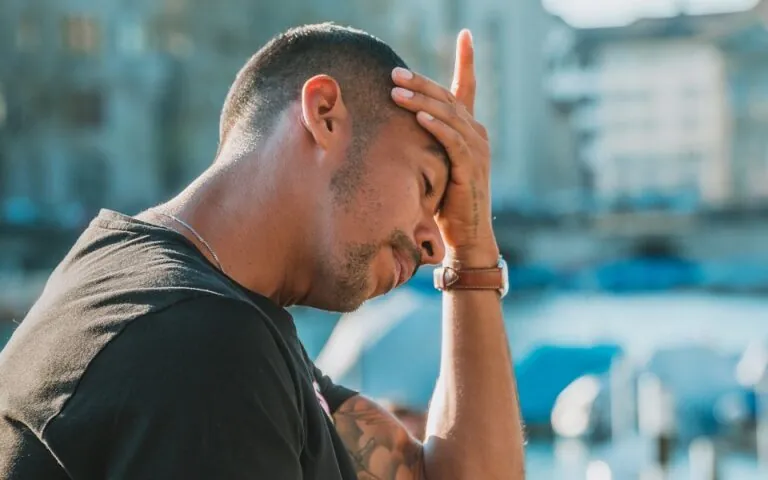
There is a trap that catches a surprising number of people, and it is one of the more satisfying things to spot at the counter: a headache that has become daily, treated faithfully with painkillers every morning, where the painkillers themselves are now causing it. It is called medication-overuse headache, and the way out is counterintuitive.
Tension-type headache is the everyday one — a dull, pressing, band-like tightness on both sides, mild to moderate, not made worse by moving about. No nausea, no visual disturbance.
Migraine is usually one-sided, throbbing, moderate to severe, and made worse by ordinary movement. It often comes with nausea and a strong dislike of light or noise, and can last from four hours to three days. Around a third of people get an aura first — typically visual zigzags or blind spots lasting up to an hour.
Cluster headache is far less common but unmistakable: excruciating pain around one eye, coming in bouts, often with a red watering eye and blocked nostril on the same side. It needs a GP.
If you take painkillers for headache on ten or more days a month — or fifteen or more for simple paracetamol or ibuprofen — and have done so for over three months, the medication can start driving the headaches. It is most common with codeine-containing painkillers and triptans.
The pattern is telling: headache present most days, often there on waking, and briefly relieved by a painkiller that then wears off into the next one.
The treatment is to stop the offending painkiller. Headaches typically worsen for one to two weeks before improving, and many people are substantially better by four to eight weeks. It is not comfortable, and it is worth doing with support — come and talk to us, or your GP, rather than attempting it blind, particularly if codeine is involved.
Call 999 or go to A&E for a headache that comes on suddenly and is extremely severe — a thunderclap headache reaching maximum intensity within seconds to a minute. Also seek urgent help for headache with:
1 Lyng Lane, West Bromwich B70 7RW · Mon–Fri 8:30am–6pm, Sat 9am–1pm · 0121 500 5756
Talk to our pharmacist →We use essential cookies to make the site work — things like your basket, sign-in and secure checkout. With your permission we’d also like to use analytics cookies to understand how the site is used and improve it. See our cookie policy.