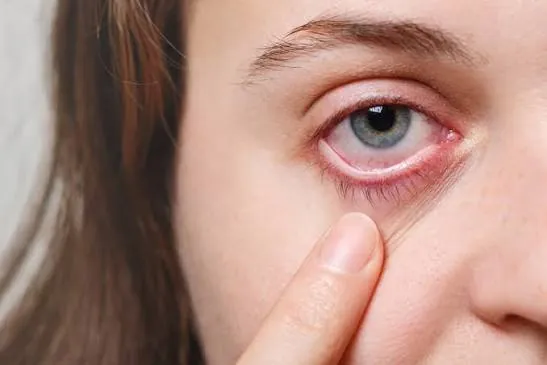
Red eye is one of the most common things people bring to the pharmacy counter, and one of the most over-treated. Most conjunctivitis clears on its own within a week or two without any antibiotic at all. The useful skill is not picking a drop — it is telling the harmless red eye from the one that needs seeing today.
Bacterial conjunctivitis typically produces thick, yellow-green discharge, and eyelids that stick together after sleep. It often starts in one eye and spreads to the other.
Viral conjunctivitis is more watery, frequently arrives alongside a cold or sore throat, and can be uncomfortable and gritty rather than painful. It is very contagious and can take two to three weeks to fully settle.
Allergic conjunctivitis affects both eyes, itches intensely rather than stinging, and usually comes with sneezing or a blocked nose. Pollen season and pets are the usual triggers.
Around six in ten cases of bacterial conjunctivitis clear on their own within a week, and the vast majority resolve without treatment. Antibiotic drops shorten things slightly but make little difference to the end result in an otherwise healthy adult.
For most people, the sensible approach is bathing the lids with cooled boiled water and clean cotton wool, lubricating drops for comfort, and patience. For allergic conjunctivitis, antihistamine eye drops are far more useful than anything antibacterial.
Chloramphenicol drops are available from the pharmacy for adults and children over two, but there are situations where they are not suitable — which is why they sit behind the counter rather than on the shelf. Ask us and we will check.
Red eye stops being a pharmacy problem and becomes an urgent one if there is:
Any of those needs same-day assessment: call us, contact your GP or an optician, or use NHS 111.
Viral and bacterial conjunctivitis both spread easily on hands and towels. Wash your hands often, use your own towel and pillowcase, and avoid rubbing your eyes. Children do not usually need to stay off school unless there is an outbreak, and contact lenses should stay out until the eye has been completely normal for 24 hours.
1 Lyng Lane, West Bromwich B70 7RW · Mon–Fri 8:30am–6pm, Sat 9am–1pm · 0121 500 5756
Speak to our pharmacist →We use essential cookies to make the site work — things like your basket, sign-in and secure checkout. With your permission we’d also like to use analytics cookies to understand how the site is used and improve it. See our cookie policy.